
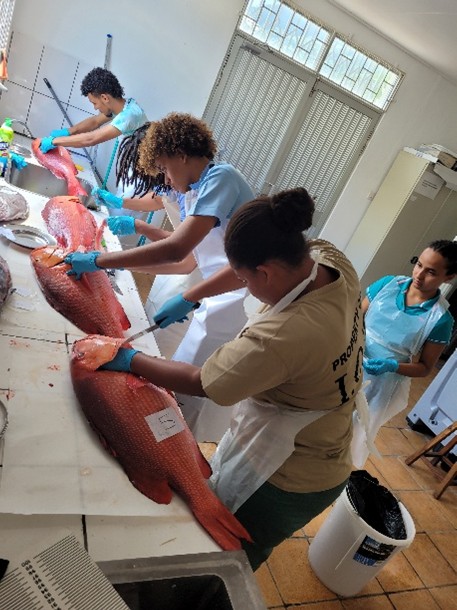
 Safeguarding the future of Seychelles’ fisheries depends on strong science and responsible management. The Seychelles Fisheries Authority (SFA) plays a central role in this effort, carrying out targeted research to better understand fish stocks and guide sustainable harvesting practices.
A key focus is fish size. Under the Mahe Plateau Trap and Line Co-Management Plan introduced in 2022, minimum size limits were set for species such as Emperor Red Snapper (bourzwa) and Green Jobfish (zob gri). These measures are designed to reduce the capture of juvenile fish, allowing them to grow and reproduce before being caught. This is critical because fish populations depend on individuals reaching maturity to sustain future generations.
Between 2022 and 2023, the SFA Fisheries Research Department conducted studies on the reproductive biology of key commercial demersal species in the artisanal fishery. Supported by the SFA, the EU Sustainable Fisheries Agreement, and the Ocean5 project under SeyCCAT, the research helped improve understanding of when fish reach maturity and how stocks can be managed more effectively.
Fish were collected from the landing sites and with the help of fishers. Researchers measured and weighed each specimen, then examined the gonads under a microscope to determine maturity. In total, the study covered hundreds of fish across important species, including groupers, snappers, and green jobfish.
The findings showed that Brownspotted grouper matures at 22.6 cm, Two-spot snapper at 43.4 cm, Humphead snapper at 50.8 cm, and Green jobfish at 40.2 cm
These results closely match international studies, strengthening confidence in their accuracy. The research also provided valuable insights into growth patterns, size-weight relationships, and reproductive behaviour—filling important gaps in knowledge about Seychelles’ demersal fisheries.
Importantly, the findings were shared with fishers and stakeholders and presented to the Implementation Committee for the Mahe Plateau Co-Management Plan (ICCP) to guide future regulations. This collaborative approach ensures that science directly informs policy and management decisions.
Through continued research and strong partnerships with fishers, the SFA is helping ensure that fishing remains sustainable, livelihoods are protected, and marine resources are secured for future generations.