
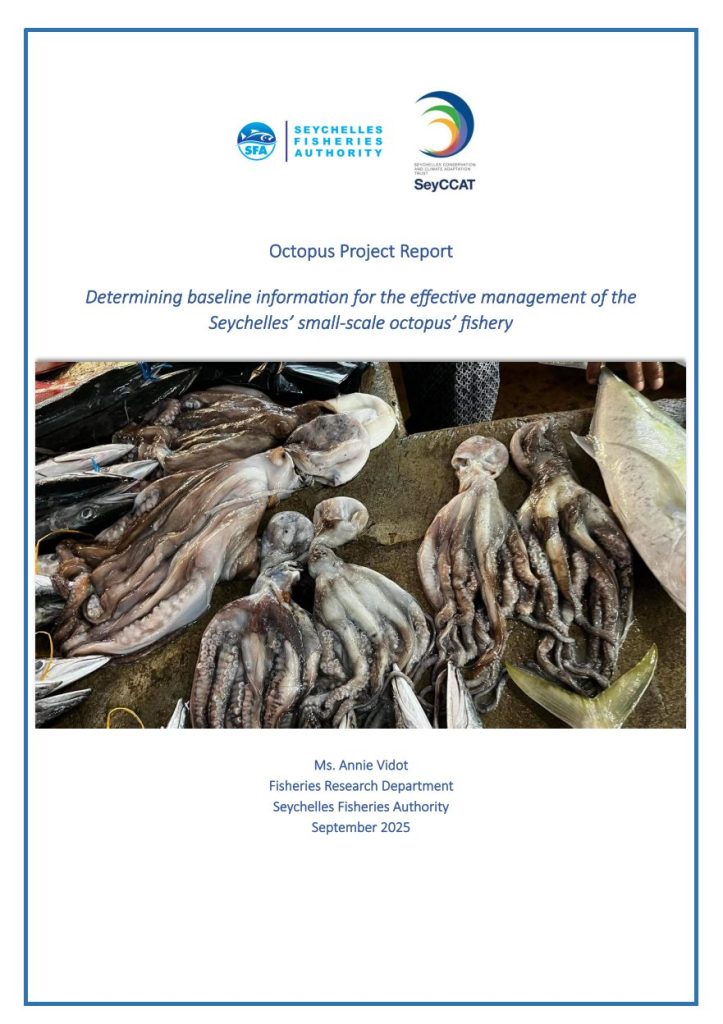
 The Fisheries Research Department of SFA has released its latest report to enhance understanding of the need for sustainable management of the country’s small-scale octopus fishery. This report is based on a comprehensive baseline study completed in 2025. Titled “Determining Baseline Information for the Effective Management of the Seychelles’ Small-Scale Octopus Fishery,” the project offers vital insights into the biological, ecological, and socioeconomic aspects of the fishery.
Octopus fishing in Seychelles has long supported coastal livelihoods, evolving from a subsistence activity into a commercially important sector. However, increasing demand, ease of access, and the absence of formal management measures have placed growing pressure on the resource. Concerns over sustainability, coupled with limited scientific data, highlighted the urgent need for a structured assessment.
With support from the Seychelles Climate Change Adaptation Trust (SeyCCAT), the study combined scientific research with active participation from fishers. Surveys were conducted across Mahé, Praslin, and La Digue, focusing on three key areas: socioeconomic conditions, catch and effort data, and habitat characteristics.
The findings revealed that the fishery remains largely male-dominated, with limited participation of women in harvesting activities. Most fishers rely heavily on octopus fishing for income, although many diversify into other fishing methods due to seasonal variability.
Biological sampling confirmed that the fishery is dominated by Octopus cyanea, challenging earlier assumptions about species composition. Over a 12-month monitoring period, more than four tonnes of octopus were recorded from 267 fishing trips, with catches peaking during favourable weather conditions.
Most octopuses caught were small to medium in size, with evidence suggesting that a majority had reached maturity. However, the relatively low number of larger individuals points to potential fishing pressure on the stock. Catch rates and fishing effort also varied significantly across seasons and locations, with more remote areas showing higher productivity.
Habitat surveys further revealed that octopus distribution is influenced by environmental factors such as depth, substrate type, and habitat complexity. While dens were widely available, octopus presence varied across sites, indicating complex habitat-use patterns.
The study indicates the need for better management. The majority of fishers engaged supported introducing measures such as licensing systems and minimum size limits to protect the resource. At the same time, concerns were raised about the open-access nature of the fishery, increasing fishing pressure, and limited stakeholder consultation.
The study underscores the importance of evidence-based management to ensure the long-term viability of Seychelles’ octopus fishery. Key recommendations include introducing precautionary management measures such as licensing and size limits, strengthening monitoring and data collection systems, enhancing stakeholder engagement through co-management approaches, and conducting further research on reproduction, growth, and population dynamics.
This project marks an important foundation for future fisheries management in Seychelles. By combining science with local knowledge, SFA is paving the way toward a more sustainable, resilient, and inclusive octopus fishery, one that continues to support livelihoods while protecting marine resources for generations to come.